
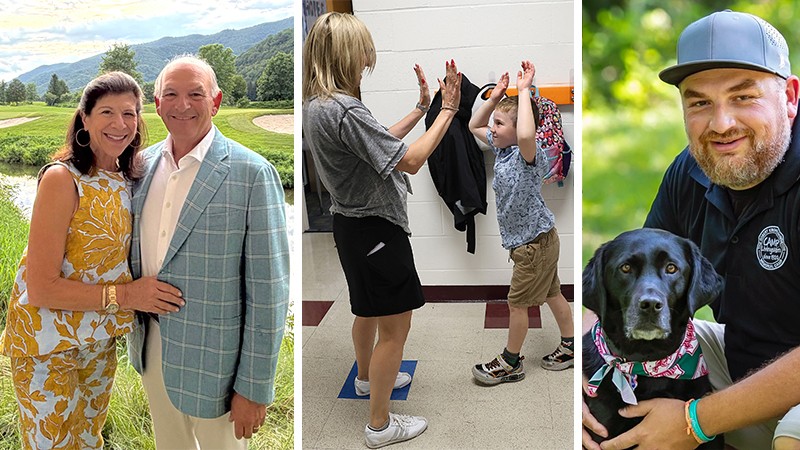
Max Yamson was nine years old when he arrived in Cincinnati from the former Soviet Union, where his family had been forced to keep their Judaism hidden. He didn’t speak English. He learned it at Rockwern Academy, still called Yavneh then, along with Israeli dancing, holiday prayers, and a solid education. A few years later, his mother told him he was going to Camp Livingston, the Jewish overnight camp an hour west in the Indiana woods.
"I cried the whole way there," he says.
Twenty-five years later, he runs the place.
His family could not have afforded full tuition for either, as they began their new life in Cincinnati. Scholarship money made Rockwern and Camp Livingston possible. “My Jewish identity was really built here,” Yamson remarks proudly. His path is one of the inspirations for Beth and Louis Guttman’s transformational gift to both institutions.
"Max’s story is remarkable," Beth Guttman says. "Camp Livingston gave him a Jewish life he probably wouldn't have had."
The Guttmans have created the Beth and Louis Guttman Endowment Fund for Investing in the Jewish Future, a permanent fund built to open paths like Yamson’s for generations of Cincinnati children.
Each year it will provide scholarship money for both institutions, so that whether a child gets a Jewish education and a Jewish summer depends more on what a family hopes for, and a little less on what it can pay.
The Guttmans could have picked either institution. They deliberately chose both. That choice reinforces an observation made by Rabbi Laura Baum, the head of school at Rockwern. "Jewish overnight camp and Jewish day school are two of the strongest predictors of lifelong engagement in Jewish life," Rabbi Baum says.
The numbers back her up. In his State of World Jewry address last year, author and podcaster Dan Senor cited research showing that day school alumni are more than twice as likely to feel deeply connected to their Jewish identity, and four times as likely to feel a strong connection to Israel. In one survey, 92 percent of parents said Jewish camp directly strengthened their child's Jewish identity. Day schools and camps, Senor argued, are no longer nice-to-haves. "They are indispensable."
Listening to Senor’s remarks sharpened the Guttmans’ resolve. "In today's environment of antisemitism and anti-Zionism, a proud Jewish identity is hard for kids. Really hard," Beth says. "Camp and day school help solidify their Jewish identity and help them feel good about it," adds Louis.
Yamson has watched it play out in real time: the campers who come back summer after summer are the ones he later spots leading Jewish life on college campuses, sitting on committees, and serving on boards of Jewish organizations. It’s personal for him, too. His two-year-old son starts at Rockwern this year.
But none of this is inexpensive, and costs are climbing. A single session at Camp Livingston now runs several thousand dollars. A year at Rockwern is more. And the full price of a Jewish childhood, once a family adds activities, day camp, synagogue membership, JCC membership, and everyday expenses, climbs quickly out of reach.
"Scholarship has never been more important," Yamson says. The need has spread to families who never expected to ask; he now sees requests from households that just a few years ago, on paper, looked comfortable.
"It's very expensive to operate,” Beth Guttman says. “And not everybody who wants to do it, can." The Guttman fund is built to move the line for those families, so that fewer children are turned away for reasons that have nothing to do with how much they want to be there. Rabbi Baum has a standing invitation for any parent who assumes the answer is no: "Don't let the fear of a price tag stop you. Give us a call."
Yamson carries the same conviction. “I’m a phone call or email away. If we don't immerse our children in Jewish life early and often, our people disappear," he says. "That's why I run a Jewish summer camp."
Neither of the Guttmans attended a Jewish day school or a Jewish camp, but they understood how important both would be for their own children. They sent them to Rockwern when it was still called Yavneh and watched their Jewish identity take hold in an early-grade ceremony where each child received a Torah of their own. "It's the most beautiful ceremony," Beth says, smiling. "It created in them a love for their Jewishness." This fall, the Guttmans' grandson, Nani, enters Rockwern.
For a couple that has given so much already, this feels different. "It feels active," Louis says. Beth agrees. "The idea that kids are going to get this opportunity for years and years is exactly what drives us." Yamson, has seen endowments hold camps steady for decades and calls that the most forward-thinking kind of giving there is. The fund will grow as operating costs do, and reach "more families and families in more need."
It’s what we mean at the Jewish Federation of Cincinnati when we say “philanthropy”: love of humanity, put into action. The Guttmans’ gift lands exactly where our community’s Cincinnati 2030 plan says to invest: Jewish engagement at the life stages that shape identity most. Gifts like theirs are how a community builds itself, generation by generation.
In some future summer, after finishing the school year at Rockwern, another nine-year-old will cry the whole way to Camp Livingston, then quickly learn to love it, because a scholarship made it possible. And if it works the way it has worked for Yamson and thousands like him, they will grow up proud of being Jewish and carry this community forward. That’s the whole idea. "We want to invest in institutions that provide immersive Jewish experiences and help develop Jewish pride," Beth Guttman says, "long after we're gone."
Questions about sending a child to Rockwern Academy or Camp Livingston? Contact them at rockwernacademy.org or 513-984-3770 and camplivingston.com or 812-427-2202.